Showing posts with label attachment. Show all posts

Sunday, August 2, 2015

My Kids, the Amygdala and Me

School starts in a week here and my big three are all going nuts.  Every single one of them has been struggling this week.  Bickering with the occasional bout of sibling violence.  Back talk and eye rolling.  Arguing.  Nonsense questions.  Constant chatter.  Silly noises and excessive loudness.  They are driving us a bit batty.

They all know change is coming and are unsettled and antsy.  It is definitely easy to look at the craziness and be annoyed.  In all honesty, my kids are irritating the stink out of me.  But underneath all of that, there is more.

It helps to know that their brains are reacting to the transition between summer and school and to really understand the brain science behind their behavior.  Ding, ding, ding!  Here's the important part, the cliff notes version:   anxiety and impulsivity are actually managed by the same portion of the brain.  The limbic system is the part of our brain that is responsible for our emotions.  Within that portion of our brain is a small section called the amygdala.  The amygdala controls how we respond to stimuli.  In the case of stressful situations, our amygdala hijacks our ability to rationally think and instead creates more of  a spontaneous, instant reaction.  Sometimes, that's good.  We see a car hurtling down the street, so we yell at our kids to stop and instantly grab their hands.  Sometimes, that's not so good.  We feel stressed and anxious and momentarily lose our ability to logically act.  We get angry at another driver while on the road and say not so nice things.  We head to an event where we know no one and find ourselves struggling to even introduce ourselves.

For our kids, this back to school transition time means their brains are now flooded with thoughts that are both exciting and stressful.  Like marbles set loose inside of a cake pan, thoughts like "I can't wait to see my friends!" and "I hope they serve pizza for lunch on the first day!" roll right alongside thoughts like "What if I can't get my locker open?" and "What if I get into the line and no one, absolutely no one, says hello to me?"  As kids consciously (or subconsciously) worry and fret about potential issues and the uncertainty of the unknown, the amygdala jumps in and acts.  There is no thinking through how actions connect to consequences.  They get wild and crazy but are upset if an adult tells them to calm down.  They instigate their siblings and then act surprised when a fight erupts.  They act immature and do things they normally would not do like cutting their hair or jumping on the couch or mixing together flour and food coloring in a baking experiment that should have resulted in blueberry muffins but somehow didn't.  (Don't ask...)   The filter that should exist between their mouth and their brain gets switched off and they sass or chatter to fill the silence or make noise just because.

To be clear, having an overactive amygdala does not excuse bad behavior.  But it does give us as parents a frame of reference for understanding our kids and for interacting with them.    As with any relationship, it helps to redefine the relationship and remember that the other party is not the enemy.  If you are in the same boat as me, where you are looking at the last remaining days of summer and fear for your sanity due to your kids' behaviors, repeat after me, "My kids are not the enemy."  Anxiety and fear are the enemy, tools created by Satan to cripple and bind,  to divide and isolate.

It also helps to interact with our kids in a way that makes them emotionally resilient, to help them recognize that they are feeling anxious and to speak truth to them as they combat that anxiousness.  Maybe they need to say their worries outloud.  Maybe they need someone to speak truth to them about who they really are, that they are a friendly, loving, smart kid who is capable.  Maybe they need someone to fill their love tank up with physical affection.  Maybe they need to problem solve their potential problems and to create an action plan for those items that really are bothering them.  Those things all increase their felt safety which basically means that if our kids feel safer, then they will act in more rational ways.

For me, probably the hardest thing is to not let my kids' stress become my own stress.  Cranky wackadoo kids often means for a cranky wackadoo mom which often means more yelling and less gentleness.   Unfortunately, that's all a bit cyclic.  Yelling and stomping and punishing and being harsh usually just amps up the stress level which in turn just feeds Mr. Amygdala and results in more impulsive, anxious behavior.

So what's a mom to do?  We're heading out this week on several day trips to the YMCA pool and to the children's museum.  The pool at home and the slip and slide are ready to go.  We might hit the library.  We're going to try to keep ourselves busy and not bored.  I'm going to try to let go of my own agendas for cleaning and my own projects so I am able to be more present and not annoyed by the constant interruptions that I would surely have.

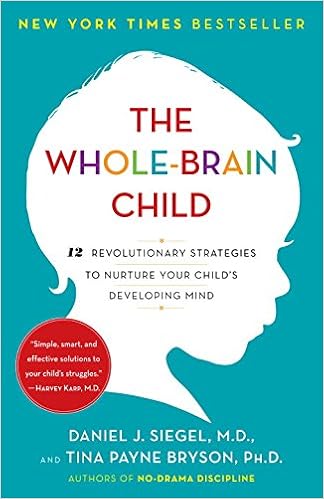
Want to know more?  Dan Siegel has a ton of books on brain science and parenting.  They are easy to read, practical and insightful.



Thursday, November 21, 2013

My Learning Curve

I've been a mom for over 7 years with at least one child actually in my home for almost 5 of those 7 years.  However, it's easy for me to overlook certain things, to be frustrated by behavior and be a slow learner in terms of figuring out how to deal with that behavior.  This week was no exception.

One of my kids was being a real pain.  Sneaking candy out of the cupboard.  Taking a sibling's toy that was put away after being told to leave the toy alone.  Refusing to do even the simplest of tasks without a battle.  Being told to stop and quickly doing the action a few more times just because.

With this particular child, you cannot out consequence the behavior.  Think a spanking might change the behavior?  I'm willing to bet you could spank until bloody and the child would still not change the behavior.  Think taking away toys or priveleges will affect the behavior?  This child would end up spending every night alone in an empty bedroom and still be having behavior problems.  What about writing sentences or doing extra chores?  Um, all that gets you is a headache from nagging to accomplish the tasks because the child drags their feet and refuses to complete the tasks.

I am not saying this child does not get consequences.  What I am saying is that if you are trying to change the behavior by creating a consequence that is so negative, so awful that this child will think twice about doing it again, if that is your goal, you will fail.  It is instead about the heart.  For this child, when inclined, everything becomes a power struggle.  It's a way to maintain control.  And the response to consequences are no exception as the child wills themselves to outlast you (even if that has never happened and even though the child can verbalize how this type of power struggle never works out well for them.)

Consequences cannot be the reason the child stops; consequences instead are a natural outpouring of what happens because of a certain behavior.  If you take your brother's toy, you must apologize and do a kindness for him.  If you color on your dresser, you clean it off.  (And then the next time you want to get the crayons out at the table, I remind you that you have been having problems being trustworthy with the crayons so I'm not sure you can handle the crayons at this moment but perhaps tomorrow will be a chance to try again.)

So if consequences do not change the heart, what does?  And what does this have to do with Mama learning a lesson yet again?

The traditional parenting approach might find you as a parent becoming even more hard nosed.  The parent might continue to apply consequences until the child's will breaks.  But for me, this was a time to consider why these behaviors were surfacing.  The aha of "oh yes, Mama is leaving for 3 days.  This kiddo is feeling out of control because of that."

So how do you regulate that?  How do you empower your child to feel back in control?  By making them feel safe and secure and loved.  By spending more time with them.  By holding more and talking more and hugging more.

And sure enough, the words started to come with a few tears as well.  "I don't want you to go."  "Why can't I go with you?"  "I'm afraid you will get hurt in a car accident."

In no way does the state of the child's heart excuse the bad behavior.  The child still has to deal with how their actions affect others.  But if I as the mom can get to the root of the behavior, then perhaps I can reduce the feelings that are causing the behavior and reduce the bad behavior.

It's whispering in their ear at church as you sing a song about the very presence of God, reminding them that even if Mama is gone, God is always there.  It's encouraging that child to ask for a hug rather than feeling badly all alone. It's reminding them of a Bible verse like "When I am afraid, I will trust in You."   It's hearing the child say "Oh yeah!  There's our picture up there!  I can just look at that and see you!"  It's hearing the child say to their dad on the morning after I leave, "We're going to be just fine."  It's a papa who lets the child sleep in his bed while Mama is away.

It's shoring up the child's heart rather than breaking the child's will.

 (Now too bad I realized what was really going on the day before I left rather than the week before when all the power struggles were happening...)

Tuesday, February 8, 2011

Funky Food Stuff

It's one of those things that you just can't put your finger on.  It's one of those things that is just a bit off.  It's one of those things where you convince yourself of one thing and then spend time second guessing the convictions you have.

The "it" in question could be anything.  It's some small, semi subtle behavior that your adopted child exhibits that just resonate in a weird way.  It happens to often to be completely innocent.  But it's not so dramatic that it interferes with every aspect of normal life.  If you are parenting a kiddo who does not see to have a major or somewhat major issue (be it attachment, cognitive delays, etc.), there's a chance you know exactly what I'm talking about.

For us, one of those behaviors centers around one of our kiddos and his/her food habits.  For kids who are struggling with attachment issues, hoarding food or stealing food can be major issues.  We are not dealing with that.  Instead, we have a child who wakes up every morning asking for food, demanding to be fed.  This same child is what I call a food scavenger.  This child snoops for food. As in looking in the garbage can for food during the first few months home.  As in opening cabinets looking for food.  As in keeping a keen eye on the kitchen counters for food.  And if there is food in one of those place, this child must touch it.  He/she doesn't always eat it, but, especially in the first few months home, touching it was almost always a given.  Sometimes this child sneaks the food off of the counter.  If food is present, it's as if the child has turned into a bloodhound on a scent trail.  They search out the food.  They look at whomever has the food with a look that says, "please feed me."  It does not matter if they have just eaten.  They will ask for the food.  They will, at times, beg for the food. 

Yes, some of it is a child's attempt at finding boundaries.  Some of it seems like something other 3 or 4 year olds might try.  But there is something about it that is not the same.

It seems a bit too intense to be normal.  It's as if this child gets fixed on food in a slightly unusual way.

I honestly believe that most of this is related to the way food is distributed in orphanages.  At an orphanage, food is dispersed on a strict schedule.  Breakfast, lunch, snack, and dinner all occur at specific times each day.  Food is only available at these times.  (It should be noted this child has never known extreme hunger like some children have who come to live in orphanages.  And the orphanage this child lived in did provide 3 meals and a snack every day.)  Contrast orphanage living to what it is like to live in a family. 

Yes, families often serve food at routine times.  But food is an ever present thing in a family setting.   By that, I don't mean that the food is always out and presented to the child.  Instead, I think that living in a home with cabinets and refrigerators and freezers full of food must be a completely mind boggling thing for a child who grew up in an institution.  Food is everywhere!  

In an orphanage setting, there are no dinner rolls cooling on the counter that you must wait until suppertime to eat.  In an orphange, there is no left over Christmas candy sitting in a bag, easily accessible to little hands.  In an orphanage, if you ate a few hours ago and it's not snack time yet, you have no way to get food so it makes waiting to eat until snack time a relatively easy thing.  And in an orphanage, food is not wasted so food thrown into a garbage can in a family home must be something that a little mind is not sure how to process.  In general, in a home, it is very easy to know where the food is and how to access it.  The temptation to get into the food is everywhere. 

In an orphanage, if a visitor or worker does bring special treats, it is often first come, first serve so it is a good idea to eat quickly and see if you can get seconds.  Specials treats are not able to be kept for a later time.  In a home, if the amount of special treats are limited, usually the treats are stored to eat later.

 It's actually the way one of my kiddos reacted in a situation with special treats that made me decide to write this post.  A few weeks back, at story time, the town librarian handed out treats to all the kids and then announced that there weren't enough for seconds but there were enough for the adults to have treats too.  My kiddo didn't hear or didn't understand what was said but saw that the treats were being passed out again.   He/she started shoveling the rest of the treat into his/her mouth, hoping to finish quickly and go back and get another, beating out the other kids who were still eating.

For us, we've chosen to go a couple of different routes in addressing this.  When the child first came home, we let it slide and instead encouraged the child to use his/her words to ask for food.  We tried to teach the child that if he/she wanted food, he/she needed to ask.  And we rarely told the child no if he/she asked in an appropriate way.  After we felt sure that the child understood we would provide the food, we then went back and changed our strategy a bit.  We chose to address it by looking at the child's heart.  What is impacting the child's choices?  In our case, we have focused on the words from 1 Corinthians 13, "Love always trusts."  This means love trusts that I will have food when I need it, not just when I want it.  This means that love trusts that Mama and Papa know what's best for me in terms of when and what I eat.  This means that love trusts that if Mama or Papa say we can eat a certain food later, it means we really will eat it later and I do not need to take it right now. 

And there have also been some logical consequence dished out.  Caught drinking out of Mama's pop can without asking?  (Which one of mine does often.)  You get water for the day.  Continually touching food on the counter?  (Which happens all the time and is often not just limited to food items but often includes the child touching all sorts of stuff that he/she is not supposed to.)  The child has now been given the task of giving themselves a spanking on the hand for every infraction.  (Suprisingly, I think it's worked well.  Spanking yor own hand gets old when you have done it 20 times over the course of the day.)  I've also made the offender tell the hand why it's getting spanked.  (Which can be kind of funny to hear.) 

Little by little, bit by bit, I think we're seeing progress.  Believing hearts can heal even if it's from something that seems like a minor owie...

Thursday, July 23, 2009

Attachment Worries

I think for every adoptive parent there is a nagging voice in the back of their head that makes them question the reason for behaviors their children are exhibiting. It's hard not to be overvigilant in monitoring what your child is doing and the emotional implications of it. So when we met with our case worker to do our 6 month post placement visit and she expressed some concerns about Kenson, I was a little unnerved. Up to that point, I had felt that Kenson was doing a great job of attaching and adjusting and that we had no real concerns. Our case worker listened to me relate how Kenson did not want to stay in the church nursery and seemed very worried about this. It made me question what my gut was feeling. It made me concerned that maybe we were standing on the brink of some large looming attachment difficulties.

After talking with D about it, he and I both agreed that while we respected the social worker's opinion, we thought she had overreacted a bit to the situation. Yes, Kenson has been reluctant to stay in the church nursery. But my gut was saying that it wasn't based in a fear of abandonment. Rather, it seemed to me a fear of allowing someone else to take care of him as if he didn't trust that anyone other than Mama or Papa could take care of him. We also felt like the drama that was involved was indicative of all of his recent behavior. He has been doing a lot more 2 year old type tantrums when he doesn't get his way. Nothing major but he is definitely showing his true colors more when he is not allowed to do what he wants. And us leaving him in nursery has been just that: Kenson not getting his way.

Other than the nursery, we have seen nothing but positive signs of attachment. He has longed for eye contact and nurturing from day one. He only chooses us for comfort. He does not hoard food or fear going to sleep on his own. He is content to play in one room while we are in other spaces. He follows simple directions (most of the time) and seems eager to please. He enjoys recipricating care, often wanting to put lotion on us at bedtime or asking about our owies.

There have been a few areas where I think spending his first years away from us have influenced his behavior, but these things are not major concerns for me. For example, Kenson loves to be babied. He likes us to feed him. He has been most reluctant to dress himself. He will even take our hands and use his sippy cup like a bottle so we can feed him. Unusual perhaps for a 2 year old and perhaps a sign that he is trying to soak in those baby moments that he missed out on.

That said, I was overjoyed these past weeks as we celebrated two successes in solidifying our belief that Kenson's nursery issues are more normal kid stuff than attachment based. Two weekends ago, D and I attend an FCA Marriage Enrichment Weekend. We spent two nights away from home while my mom watched Kenson in our home. I was a bit anxious about leaving him, mostly because I wasn't sure how he would feel. (Plus, I haven't spent more than a few hours away from him since he came home so it was a bit emotional in that respect as well.) We spent about a month talking about Grandma coming and staying. And since I believed that his nursery fears were related to his anxiety over who would take care of him, we talked about all things Grandma would do while Mama and Papa were away. We talked about Grandma getting him breakfast and playing with him and kissing him goodnight. When the time came for Grandma to stay at our house, we had some "helps" thought out just in case we had issues. (A count down sheet to our homecoming and a favorite song/book we could read over the phone at bedtime.) D and I did a quick goodbye. Kenson had some sad eyes but no real tears. I really wanted to call home that night at bedtime but D thought that if we hadn't gotten a phone call saying there were problems that our call might create problems. So we didn't call until after Kenson's bedtime. He had done great. We talked to him on the phone Saturday morning and it was so funny to hear his surprised voice when he realized it was us on the phone. He did great all weekend long. And when we returned, he was glad to see us and separated from Grandma just fine. Aah, joy!

Then, this last weekend, I took Kenson to church by myself as D had a soccer game to attend. He started fussing before we even got out of the sanctuary. As we walked upstairs, I talked to him about how he would be taken care of and what kinds of things the teacher would do to take care of him. He had stopped fussing by the time we got upstairs but still wanted me to stay. I stayed but only on the outside of the door. He soon was distracted by a teacher but usually my leaving means he stops what he is doing and throws a fit. This time, it didn't. I told him I was going, reminded him of how he stayed with Grandma while Mama went bye-bye, and gave him my watch to hold until I came back. And we parted without incident. Double joy! I am hoping that continues next Sunday. (Knowing toddler/pre schoolers, I am doubtful.) But it reassured me that he is heading down the right path. It also made me wonder if maybe that visit with my mom was just the medicine he needed, a boost of confidence for him in the way that other people, not just Mama and Papa, will take care of him.

So joys this week on the attachment front. That said, I believe attachment is not a straight line drawn on a contiuum where once a child reaches a certain peak on the graph, life is all roses. Instead, I think that kids will continually deal with attachment related emotions all of their lives; as different situations arise, kids and the adults adopted kids become will find themselves facing all sorts of feelings about their birth and adopted families. I'm more of a Pollyanna personality so I try to remind myself that my children's view of adoption will be different than my own; that for them, their adoption into our family represents a trauma in their life. How deeply they hold on to that trauma is another story, but it is trauma nonetheless.

Saturday, May 30, 2009

Success

The three of us just got back from a 5 day adventure with D's brother. We traveled to Boise via plane and spent 3 full days vacationing there. In terms of attachment/adoption stuff, I would deem the trip a success. We were not exactly sure what Kenson would think of getting on an airplane again, only a few months after coming home from Haiti. Nor were we sure what we would think about several nights in a hotel. Our guess was that as long as we were there, he wouldn't care. But we weren't positive. However, we were totally right. And in terms of attachment, I see that as a huge success. He wasn't fearful of us taking him back to Haiti on an airplane, of a new situation meaning new losses. He had a great time and thoroughly wore himself out. He fought sleep at every turn; he was so afraid he was going to miss something good.

Pictures to follow.

Monday, May 18, 2009

Anxious Attachment

In the past few weeks, we've dealt with what looks like some anxious attachment in Kenson. Or at least what I think is anxious attachment. It's hard to say 'cause he's two. Two year olds like to do their own things, ya know! I do think almost all toddlers/infants go through phases of being anxious regarding their parents and separation from them. But the mom in me says it's not entirely normal toddler drama.

He has been refusing to go to Sunday school or nursery the past 3 weeks in a row. When we first came home, we started out going with him and after a few weeks, he was totally content to go by himself. But a few weeks back, totally out of the blue, we had drama when it was time for me to go. So I coddled him a bit and thought it might have been the teacher whom he didn't know very well or the fact that we had just had a wild week with too many late nights. Next week, same story. This week, ditto. I've tried staying until he's comfortable and then leaving. I've tried the cut and dry leaving. I've tried standing close to the door and trying to leave him for short segments at a time. D's tried. I've tried. And we get drama. Major drama. Flailing arms. Loud wails. A refusal to let the teacher who is in the room even get close to him all with flailing arms, loud wails, and screams of "No, no!". (You would have thought the teachers were trying to kidnap him. He put up one heck of a fight both times he couldn't get to me. The first time was intentional when I tried to just leave quickly. The second time, silly me thought I could shoot across the hall to get some paper towels to help the teacher out.) So I think we'll be back to just staying in the 2 year old room with him for a while. (Which stinks because I miss Sunday school but there are worse things in life.) I think what bewilders me the most is the mystery of it all. Why he's decided that now he is worried and anxious about us going downstairs, I don't know. But we'll ride the wave and hope it passes, especially for the sake of his little heart which has absorbed so much in the last few months.

A ha!-As I wrote all of this and read some of the comments people had, it suddenly came to me when all of this started. When I spoke at a MOPS engagement, I left Kenson in the nursery there. It was full of strange people and kids and while he didn't throw a huge fit, he was not happy. Counting backwards, it was the Sunday following all this that we started having problems. Makes more sense now. I'm thankful God popped that into my head.

Thursday, May 14, 2009

A Misspent Prom & Adoption Talk

A while back, I was reading an adoptive family's blog and something they had posted caught my eye. The mom was writing about her oldest daughter's transition into living life in a family. This daughter was a young teen and something she told her mom jumped right off the page at me. The daughter told her mom how she was envious of her younger sister who was small enough to still be held and rocked by the mother. The daughter said how she wished her adoptive mom would have been around when she was a little girl so she could have been rocked and cuddled and loved like that.

Click! For me, that girl's comments totally solidified in my head the idea behind regression and encouraging dependence in adopted children. (Adoptive parents are often encouraged to let potty trained toddlers go back to diapers, let their children use a bottle, rock their older children, make older children seek them out for food, etc. as part of encouraging attachment in their children.)

Some time ago, D told me something similar about our relationship. He said that he wished we would have known each other in high school so we could have gone to prom together. His two proms were okay but pretty blaise as he went with two friends. And my proms were, well, interesting to say the least. (I'll spare you the details.) The girl who spoke to her adoptive mom about wishing she had known her earlier in her life was saying the same exact thing D was saying to me. "I missed knowing you way back when. I think we would have had fun together. I feel like I missed out on some experiences because you weren't always in my life." Of course, a sentimental husband pining for his teenage years is not quite the same as a child thinking about the life they never got to have. But it makes so much more sense to me now.

I feel a small twinge of sadness and remorse over things I've missed doing with my husband; how much more emotion is connected to a child's heart when they recognize the things they have missed doing with their mom or dad. In Kenson, I do think I see a few indicators of these feelings in him. He often crawls up in my lap with his sippy cup and puts the cup in my hand so I will cradle him while he is drinking. And he still enjoys having D or I feed him. I'm thankful for a new perspective on these behaviors. It's easy to want to push him to be independent but I often have to remind myself that he is basking in lost opportunities, sucking up the good feelings of nurturing that, while he got from nannies, he did not get from his Mama and Papa,