Showing posts with label Parenthood. Show all posts

Sunday, August 2, 2015

My Kids, the Amygdala and Me

School starts in a week here and my big three are all going nuts.  Every single one of them has been struggling this week.  Bickering with the occasional bout of sibling violence.  Back talk and eye rolling.  Arguing.  Nonsense questions.  Constant chatter.  Silly noises and excessive loudness.  They are driving us a bit batty.

They all know change is coming and are unsettled and antsy.  It is definitely easy to look at the craziness and be annoyed.  In all honesty, my kids are irritating the stink out of me.  But underneath all of that, there is more.

It helps to know that their brains are reacting to the transition between summer and school and to really understand the brain science behind their behavior.  Ding, ding, ding!  Here's the important part, the cliff notes version:   anxiety and impulsivity are actually managed by the same portion of the brain.  The limbic system is the part of our brain that is responsible for our emotions.  Within that portion of our brain is a small section called the amygdala.  The amygdala controls how we respond to stimuli.  In the case of stressful situations, our amygdala hijacks our ability to rationally think and instead creates more of  a spontaneous, instant reaction.  Sometimes, that's good.  We see a car hurtling down the street, so we yell at our kids to stop and instantly grab their hands.  Sometimes, that's not so good.  We feel stressed and anxious and momentarily lose our ability to logically act.  We get angry at another driver while on the road and say not so nice things.  We head to an event where we know no one and find ourselves struggling to even introduce ourselves.

For our kids, this back to school transition time means their brains are now flooded with thoughts that are both exciting and stressful.  Like marbles set loose inside of a cake pan, thoughts like "I can't wait to see my friends!" and "I hope they serve pizza for lunch on the first day!" roll right alongside thoughts like "What if I can't get my locker open?" and "What if I get into the line and no one, absolutely no one, says hello to me?"  As kids consciously (or subconsciously) worry and fret about potential issues and the uncertainty of the unknown, the amygdala jumps in and acts.  There is no thinking through how actions connect to consequences.  They get wild and crazy but are upset if an adult tells them to calm down.  They instigate their siblings and then act surprised when a fight erupts.  They act immature and do things they normally would not do like cutting their hair or jumping on the couch or mixing together flour and food coloring in a baking experiment that should have resulted in blueberry muffins but somehow didn't.  (Don't ask...)   The filter that should exist between their mouth and their brain gets switched off and they sass or chatter to fill the silence or make noise just because.

To be clear, having an overactive amygdala does not excuse bad behavior.  But it does give us as parents a frame of reference for understanding our kids and for interacting with them.    As with any relationship, it helps to redefine the relationship and remember that the other party is not the enemy.  If you are in the same boat as me, where you are looking at the last remaining days of summer and fear for your sanity due to your kids' behaviors, repeat after me, "My kids are not the enemy."  Anxiety and fear are the enemy, tools created by Satan to cripple and bind,  to divide and isolate.

It also helps to interact with our kids in a way that makes them emotionally resilient, to help them recognize that they are feeling anxious and to speak truth to them as they combat that anxiousness.  Maybe they need to say their worries outloud.  Maybe they need someone to speak truth to them about who they really are, that they are a friendly, loving, smart kid who is capable.  Maybe they need someone to fill their love tank up with physical affection.  Maybe they need to problem solve their potential problems and to create an action plan for those items that really are bothering them.  Those things all increase their felt safety which basically means that if our kids feel safer, then they will act in more rational ways.

For me, probably the hardest thing is to not let my kids' stress become my own stress.  Cranky wackadoo kids often means for a cranky wackadoo mom which often means more yelling and less gentleness.   Unfortunately, that's all a bit cyclic.  Yelling and stomping and punishing and being harsh usually just amps up the stress level which in turn just feeds Mr. Amygdala and results in more impulsive, anxious behavior.

So what's a mom to do?  We're heading out this week on several day trips to the YMCA pool and to the children's museum.  The pool at home and the slip and slide are ready to go.  We might hit the library.  We're going to try to keep ourselves busy and not bored.  I'm going to try to let go of my own agendas for cleaning and my own projects so I am able to be more present and not annoyed by the constant interruptions that I would surely have.

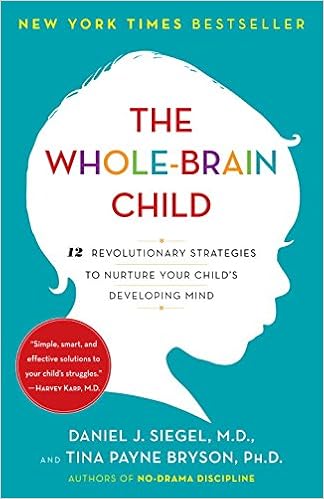
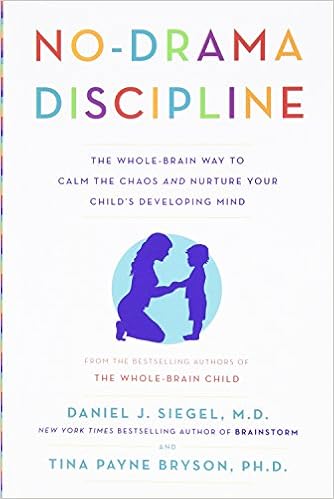
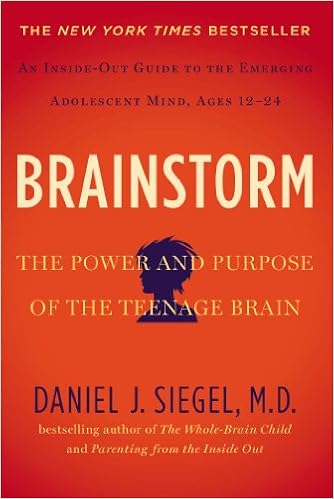
Want to know more?  Dan Siegel has a ton of books on brain science and parenting.  They are easy to read, practical and insightful.


Thursday, March 5, 2015

Truth in Parenting

A few highlights (or low lights) from the week...

Kai has a new love of toothbrushes.  Unfortunately, this new love is mostly about everyone else's toothbrushes.  So far this week, I have caught him using Conleigh's, Zeke's, and Kenson's.

4-7 is like crazy time at our house.  Between the kids getting home from school, Kai getting fussy because he is hungry and tired, and me making supper, chaos abounds.  I was trying to quell some of this by setting forth the expectations for the kids and going over what I wanted them to be doing.  I called all the kids into the kitchen for a pow wow.  As I was explaining things to them, I asked the question, "What is Mom going to be doing at 5 o'clock?"  To which Zeke replied "Yelling!"  Perhaps, perhaps, but the correct answer was cooking supper.

Discovering the real reason your sons have no clean pants is because they have been unloading their clean laundry into the dirty clothes basket and creating a lovely rat's nest of clean and dirty clothes that it literally about 4 feet high in their closet.  Also finding out that one son (probably not the one most would guess) has worn the same socks for three days in a row.

And then having your daughter tell you that she can't brush her teeth because her toothbrush is hard.  Upon inspection, you find a crustified toothbrush that hasn't possibly been used anytime in the last week (s).

Monday, March 2, 2015

And Yet: Parenting Potential

I wrote a bit the other day about parenting challenges.  I personally think most parents find it very hard to be vulnerable and authentic about their parenting struggles.  It is hard to say "my kid is struggling right now and so am I."  As some Facebook friends added to my bloggy conversation, it reminded me of so many things I have often thought about regarding parenting challenges.

Let me share one of the things I think my husband and I both struggle with in terms of parenting.

It is so hard to walk the line between holding your kids to high expectations and letting them be individuals who fail, who make mistakes, who ultimately learn from those mistakes.  We both are teachers by trade.  We see a wide variety of kids who are being parented with a wide variety of parenting styles, and it is really hard to watch kids struggle daily because there is no structure and consistency at home.  We don't want that for our kids.  We also have a Biblical background that says learning to live within boundaries and learning to live under authority (ultimately God's authority) matters.  We don't want our kids to become adults who struggle with rebellion and make bad choices, who assume the rules don't apply to them.  We also view life through the lens of loving others, that loving others is the second greatest commandment and that how we treat others matters a lot.  We don't want our children to treat others poorly be it a friend, a family member, or a stranger.

Yet, we know that discipline has to take into account individuality.  We believe that each of our kids was created in a unique, purposeful way, where certain traits are innate within them.  So often those personality traits are also their Achilles' heels, an easily manipulated weakness.   For me, I also maintain a strong belief that discipline is not about punishment, that it is instead about learning, that discipline is always about a child's heart.

So how do you let your kids spread their wings and make their own choices, albeit poor ones, while guiding and training them to be a loving, responsible adult?  It is so hard to correct without crushing, to limit without boxing in, to offer consistency and yet grace.

Throw in a child who is struggling, who repeats and repeats and repeats a behavior and it is easy to doubt yourself as a parent.  We want our kids to "get it" right now.  We see a child's struggle with repeated sin as indicative of our ineffectiveness as a parent.  In a sense, our parenting becomes a source of pride, where we puff out our chest and attribute our child's great behavior to our own genius and our child's failures to our ineptitude.

We forget that our kids are spiritual creatures who struggle with sin just like we do.  I am quick to anger and yet I want my children to always respond with gentleness.  I am careless with my words, quick to blurt out something that has not been thought through and yet I want my children to tame their own tongues and stifle their initial responses.  I am apt to criticize rather than encourage and yet I fault my children for finding fault with others.  I grumble under my breath and complain about small inconveniences and yet I hate it when my children whine or get huffy over things that frustrate them.

This Sunday, we did a bit of family time where we talked about sin and guilt.  Part of my motivation in choosing that was because I have a couple kids who can easily take sin and internalize it as shame and guilt.  We did a quick race around the house with a backpack.  The first time each child raced with an empty backpack.  The second time, I dropped in two five pound weights to symbolize guilt and talked about how guilt changes the way we operate.  We shared the story of Peter and his denial of Jesus and then read the story of Jesus confirming Peter's love for His savior and friend as well as confirming Peter's new purpose to feed His sheep.  I had never really thought about Peter as someone who should have been a prime candidate for guilt and shame.  How easy it would have been for him to have looked at his denials with intense guilt, to assume that his failures marked him forever?  And yet, Jesus saw it differently.  Jesus didn't look at Peter's behavior and abandon him.  Jesus didn't lecture, ask questions, or assume that Peter was destined for a life of apostasy.  Instead, Jesus loved him.  Jesus knew his failures, which were pretty big, and looked not at that, but instead at Peter's potential.

"Feed my sheep."

Do what I have created you to do.

And so for my kids, may my heart be more like Jesus.  More of seeing the potential of who they were created to be.  More of recognizing that failures, even big ones, even failures in a series of failures, are not fatal.  More of knowing that they are fighting some of the same battles that I am with my attitude, my tongue, my heart.