Showing posts with label Race. Show all posts

Tuesday, September 27, 2016

The Gospel of Patriotism?

Maybe it was just the weekend.  Or maybe I'm just grouchy.  I don't know.  But the last week or so has left me biting my tongue and feeling that awkward feeling of wishing for the ability to give voice to my words without entering into a futile battle because Facebook conversations rarely leave room for quality discourse or changed hearts.  That statement in and of itself is part of the problem with Facebook.  We take to Facebook to share our opinions and once we encounter someone who doesn't agree with us, we use the distance of the Internet to engage in a pointless conversation.  The Internet creates this mist-like fog that separates us from our friends and acquaintances, where we literally and figuratively argue with a wall.  What that means is that one person issues an opinion, the other responds, the original poster issues a response, and so on until both parties are tired of the debate and move on.  No one has heard a word that the other has said and really the only time someone chooses to analyze what's being said is when another person jumps into offer support thus creating an analysis of agreement rather than a thoughtful analysis of all the content in the conversation.

The topic that's left me frustrated, saddened, and a bit disheartened? In Nebraska, where people bleed and die Husker football, we recently had three Husker players kneel during the National Anthem.  I know it's been somewhat of a national conversation since Colin Kaepernick took a knee.  When three of our own players made the same choice, that brought it close to home.  Suddenly the issue of race and patriotism walked itself into our front yard.

My initial reaction when Colin Kaepernick chose to kneel was not necessarily that of approval.  I thought in my head and said to my husband that it didn't seem like the right avenue for such a protest, that perhaps there were better, more effective ways to communicate the same message, in a way that might cause people to listen rather than argue.  I let it go at that.

Then, Saturday evening, three Husker players kneeled and Husker Nation lost their minds.  I've seen friends make known their own opinions via their Facebook pages.  I've seen the comments left on news articles, some of which were comments left by friends.  And I've walked away shaking my head because of the meanness, name calling, and overall attitude by both my friends and people whom I do not know.  The people I do not know cause my heart to break a bit but truly what really does a number on my heart is to see my Christian friends join right in.  It's not that I expect my Christian friends to be perfect.  It's more that it is hard to watch Christians choose patriotism over the gospel of grace and love.

In general, the irony of the disapproval is not lost on me.  People are quick to point out how these players are really just entertainers, contrasting them with real heroes like military personal.  That line of thinking is certainly one I think most of us would agree with.  However, what makes someone a hero?  Heroes are made because they choose the hard way instead of the easy way, because they found a way to do the right thing in the middle of doing their everyday, ordinary life.  Of course, a football field is not a battle field, and one would be remiss to think that playing football is just as difficult as being a soldier.  Of course, those football players could have chosen to enlist instead of play ball.   They didn't, and they are living in the place where God has them in this moment, and in this moment, they are doing something that is not popular.   The easy road would be to be a football player who only cares about his own ego and his own success.  The easy road would be to ignore the hard conversations that are happening in our country right now.  They are not choosing that.  They are choosing the hard, trying to make a difference within their spheres of influence.

Similarly, it strikes me as ironic when people hold up the freedoms we have in this country as hard fought by our military while in the same breath denouncing someone's right to exercise that freedom.  If we want to one of our country's greatest strengths to be the voice of its people, then we cannot tack on the caveat of people having that right but only as long as they do it in a way that we find acceptable.   It also seems like there is a component of supporting the person's right to protest but only if it's a cause we can get behind.  If an evangelical player kneeled for the National Anthem in protest of our nations' same sex marriage laws, what would be the response?  If a Catholic player kneeled for the National Anthem in protest of our nation's abortion policies, would we be as outraged?  Or we would applaud that person's bravery and willingness to stand up for what he believed to be right?  Is part of the issue that we do not believe in the merit of the protest because our perspective on race issues is so different from those protesting?

I have also been frustrated over the meanness and hate that seems to pervade the conversations.  Calling people idiots, ungrateful, disgraceful, losers, and spoiled brats is mean.  Using racial slurs, threatening to lynch someone, or threatening physical violence is hateful.  It is okay to share an articulate response to why you disagree with someone's protest.  It is not okay to offer up a 3-5 word comment that insults someone and only serves to incite similar comments.  To be quite honest, that's passive aggressiveness.  I do not understand why the topic of civility is even an issue nor do I understand why people continue to think such conversations about civility do not apply to them.  I wish I were just talking about people whom I don't know, people who have left random comments on news article but I'm not.

I'm hoping these words are slightly better than a rant, that they are a part of heartfelt and intentional dialogue not just throwing words into the air to prove who is most right.  Patriotism is so much more than an anthem or a flag.  For us as Americans, patriotism has to be about the ideals of our Constitution which include the right of people to protest and criticize even if it's done in a way in which we don't agree.  If patriotism is watered down into simply an action we do in regards to a flag or a song, then we are like hundreds of other nations that were or are ruled by corrupt governments, tyrants, and dictators.

I'll leave you with the press conference held yesterday by Michael Rose-Ivey, one of the three Husker football players who chose to kneel.  If you watch it and still see him as spoiled, disrespectful, or an idiot, I'm at a loss.  He is a man struggling to find a way to make a difference.  Listen to what he is saying. Listen not so you can argue your position but so you can understand his perspective.  You may not agree with the action he chose but to vilify him is a position I refuse to take.


Thursday, July 7, 2016

The Day I Became Colored

I am colored but I offer nothing in the way of extenuating circumstances except the fact that I am the only Negro in the United States whose grandfather on the mother's side was not an Indian chief. 

I remember the very day that I became colored. Up to my thirteenth year I lived in the little Negro town of Eatonville, Florida. It is exclusively a colored town. The only white people I knew passed through the town going to or coming from Orlando. The native whites rode dusty horses, the Northern tourists chugged down the sandy village road in automobiles. The town knew the Southerners and never stopped cane chewing when they passed. But the Northerners were something else again. They were peered at cautiously from behind curtains by the timid. The more venturesome would come out on the porch to watch them go past and got just as much pleasure out of the tourists as the tourists got out of the village. 


The front porch might seem a daring place for the rest of the town, but it was a gallery seat for me. My favorite place was atop the gatepost. Proscenium box for a born first-nighter. Not only did I enjoy the show, but I didn't mind the actors knowing that I liked it. I usually spoke to them in passing. I'd wave at them and when they returned my salute, I would say something like this: "Howdy-do-well-I-thank-you-where-you-goin'?" Usually automobile or the horse paused at this, and after a queer exchange of compliments, I would probably "go a piece of the way" with them, as we say in farthest Florida. If one of my family happened to come to the front in time to see me, of course negotiations would be rudely broken off. But even so, it is clear that I was the first "welcome-to-our-state" Floridian, and I hope the Miami Chamber of Commerce will please take notice. 


During this period, white people differed from colored to me only in that they rode through town and never lived there. They liked to hear me "speak pieces" and sing and wanted to see me dance the parse-me-la, and gave me generously of their small silver for doing these things, which seemed strange to me for I wanted to do them so much that I needed bribing to stop, only they didn't know it. The colored people gave no dimes. They deplored any joyful tendencies in me, but I was their Zora nevertheless. I belonged to them, to the nearby hotels, to the county--everybody's Zora. 


But changes came in the family when I was thirteen, and I was sent to school in Jacksonville. I left Eatonville, the town of the oleanders, a Zora. When I disembarked from the river-boat at Jacksonville, she was no more. It seemed that I had suffered a sea change. I was not Zora of Orange County any more, I was now a little colored girl. I found it out in certain ways. In my heart as well as in the mirror, I became a fast brown--warranted not to rub nor run. 


But I am not tragically colored. There is no great sorrow dammed up in my soul, nor lurking behind my eyes. I do not mind at all. I do not belong to the sobbing school of Negrohood who hold that nature somehow has given them a lowdown dirty deal and whose feelings are all but about it. Even in the helter-skelter skirmish that is my life, I have seen that the world is to the strong regardless of a little pigmentation more of less. No, I do not weep at the world--I am too busy sharpening my oyster knife. 


Someone is always at my elbow reminding me that I am the granddaughter of slaves. It fails to register depression with me. Slavery is sixty years in the past. The operation was successful and the patient is doing well, thank you. The terrible struggle that made me an American out of a potential slave said "On the line!" The Reconstruction said "Get set!" and the generation before said "Go!" I am off to a flying start and I must not halt in the stretch to look behind and weep. Slavery is the price I paid for civilization, and the choice was not with me. It is a bully adventure and worth all that I have paid through my ancestors for it. No one on earth ever had a greater chance for glory. The world to be won and nothing to be lost. It is thrilling to think--to know that for any act of mine, I shall get twice as much praise or twice as much blame. It is quite exciting to hold the center of the national stage, with the spectators not knowing whether to laugh or to weep. 


The position of my white neighbor is much more difficult. No brown specter pulls up a chair beside me when I sit down to eat. No dark ghost thrusts its leg against mine in bed. The game of keeping what one has is never so exciting as the game of getting. 


I do not always feel colored. Even now I often achieve the unconscious Zora of Eatonville before the Hegira. I feel most colored when I am thrown against a sharp white background. 


 For instance at Barnard. "Beside the waters of the Hudson" I feel my race. Among the thousand white persons, I am a dark rock surged upon, and overswept, but through it all, I remain myself. When covered by the waters, I am; and the ebb but reveals me again. 


Sometimes it is the other way around. A white person is set down in our midst, but the contrast is just as sharp for me. For instance, when I sit in the drafty basement that is The New World Cabaret with a white person, my color comes. We enter chatting about any little nothing that we have in common and are seated by the jazz waiters. In the abrupt way that jazz orchestras have, this one plunges into a number. It loses no time in circumlocutions, but gets right down to business. It constricts the thorax and splits the heart with its tempo and narcotic harmonies. This orchestra grows rambunctious, rears on its hind legs and attacks the tonal veil with primitive fury, rending it, clawing it until it breaks through to the jungle beyond. I follow those heathen--follow them exultingly. I dance wildly inside myself; I yell within, I whoop; I shake my assegai above my head, I hurl it true to the mark yeeeeooww! I am in the jungle and living in the jungle way. My face is painted red and yellow and my body is painted blue. My pulse is throbbing like a war drum. I want to slaughter something--give pain, give death to what, I do not know. But the piece ends. The men of the orchestra wipe their lips and rest their fingers. I creep back slowly to the veneer we call civilization with the last tone and find the white friend sitting motionless in his seat, smoking calmly. 


"Good music they have here," he remarks, drumming the table with his fingertips. 


 Music. The great blobs of purple and red emotion have not touched him. He has only heard what I felt. He is far away and I see him but dimly across the ocean and the continent that have fallen between us. He is so pale with his whiteness then and I am so colored. 


At certain times I have no race, I am me. When I set my hat at a certain angle and saunter down Seventh Avenue, Harlem City, feeling as snooty as the lions in front of the Forty-Second Street Library, for instance. So far as my feelings are concerned, Peggy Hopkins Joyce on the Boule Mich with her gorgeous raiment, stately carriage, knees knocking together in a most aristocratic manner, has nothing on me. The cosmic Zora emerges. I belong to no race nor time. I am the eternal feminine with its string of beads. 


I have no separate feeling about being an American citizen and colored. I am merely a fragment of the Great Soul that surges within the boundaries. My country, right or wrong. 


Sometimes, I feel discriminated against, but it does not make me angry. It merely astonishes me. How can any deny themselves the pleasure of my company? It's beyond me. 


But in the main, I feel like a brown bag of miscellany propped against a wall. Against a wall in company with other bags, white, red and yellow. Pour out the contents, and there is discovered a jumble of small things priceless and worthless. A first-water diamond, an empty spool, bits of broken glass, lengths of string, a key to a door long since crumbled away, a rusty knife-blade, old shoes saved for a road that never was and never will be, a nail bent under the weight of things too heavy for any nail, a dried flower or two still a little fragrant. In your hand is the brown bag. On the ground before you is the jumble it held--so much like the jumble in the bags, could they be emptied, that all might be dumped in a single heap and the bags refilled without altering the content of any greatly. A bit of colored glass more or less would not matter. Perhaps that is how the Great Stuffer of Bags filled them in the first place--who knows?  (How It Feels to Be Colored by Zora Neale Huston)


The day I became colored...that phrase just gets me.  Ask me what I worry about for my kids of color and that phrase is it.   I dread the day they feel colored.

Not that they don't already know they are brown.  Or called black even though black is such a misnomer.  They know that they are brown.  They know we don't match.  They know that they are often dots of brown in a snowy white landscape.  Yes, that they know.

But what they don't know is that they are colored.  They don't know yet that the world is a pretty ugly place sometimes and that there will be times they will be on the receiving end of such ugliness through no fault of their own.

I mean, that happens to us all.  But there is something so stinging and sharp about ugliness that stems from who you are as a person.  One can argue that my children should not be defined by their blackness.  I agree. They are so much more.  And yet, their blackness is a part of them. I cannot ignore that there heritage truly is African, that they are the grandchildren of former slaves, that their history is that of the world's first successful slave rebellion, that most won't know their heritage but will presume them to be black Americans, that they will be often described as a black man and a black woman, with whatever connotations are attached to the speaker's thoughts.

Right now, they are safe and sheltered.  In our little town, they belong to us.  Our school, our neighbors, our friends, our family-they have claimed my kids as their own.  At some point, that will change.  They will not be Kenson of Crete or Conleigh of Crete but they will instead be just another colored boy or just another colored girl in a sea of people.  And what then?

I want to believe that the greater community, that vast group of people who were all created in the image of God, will still claim them as their own.  But my guess is there will come a day when my kids realize they are colored.  Because of the words someone said.  Because of the way someone acted.  Because of the news story they just saw.   My kids will not be exempt because they are good kids from a good family from a nice little town.

I don't say these words lightly nor do I believe the bogeyman lurks around every corner.  I say these words because at some moment every black person becomes colored.  Every black person has to take a moment or two or four and reconcile who he is with what he has been made to feel.

I pray for my kids that the world will be better or different somehow, that somehow fear and suspicion and skepticism and anger will not be the biggest emotions defining racial relations.  I pray they will be a Zora, who wonders why anyone would want to deprive himself the presence of my children.  I pray they will have their oyster knife ready in their hands, because the world is their oyster, because while they may be colored, they are not tragically black.


The Day I Became Colored

I am colored but I offer nothing in the way of extenuating circumstances except the fact that I am the only Negro in the United States whose grandfather on the mother's side was not an Indian chief. 

I remember the very day that I became colored. Up to my thirteenth year I lived in the little Negro town of Eatonville, Florida. It is exclusively a colored town. The only white people I knew passed through the town going to or coming from Orlando. The native whites rode dusty horses, the Northern tourists chugged down the sandy village road in automobiles. The town knew the Southerners and never stopped cane chewing when they passed. But the Northerners were something else again. They were peered at cautiously from behind curtains by the timid. The more venturesome would come out on the porch to watch them go past and got just as much pleasure out of the tourists as the tourists got out of the village. 


The front porch might seem a daring place for the rest of the town, but it was a gallery seat for me. My favorite place was atop the gatepost. Proscenium box for a born first-nighter. Not only did I enjoy the show, but I didn't mind the actors knowing that I liked it. I usually spoke to them in passing. I'd wave at them and when they returned my salute, I would say something like this: "Howdy-do-well-I-thank-you-where-you-goin'?" Usually automobile or the horse paused at this, and after a queer exchange of compliments, I would probably "go a piece of the way" with them, as we say in farthest Florida. If one of my family happened to come to the front in time to see me, of course negotiations would be rudely broken off. But even so, it is clear that I was the first "welcome-to-our-state" Floridian, and I hope the Miami Chamber of Commerce will please take notice. 


During this period, white people differed from colored to me only in that they rode through town and never lived there. They liked to hear me "speak pieces" and sing and wanted to see me dance the parse-me-la, and gave me generously of their small silver for doing these things, which seemed strange to me for I wanted to do them so much that I needed bribing to stop, only they didn't know it. The colored people gave no dimes. They deplored any joyful tendencies in me, but I was their Zora nevertheless. I belonged to them, to the nearby hotels, to the county--everybody's Zora. 


But changes came in the family when I was thirteen, and I was sent to school in Jacksonville. I left Eatonville, the town of the oleanders, a Zora. When I disembarked from the river-boat at Jacksonville, she was no more. It seemed that I had suffered a sea change. I was not Zora of Orange County any more, I was now a little colored girl. I found it out in certain ways. In my heart as well as in the mirror, I became a fast brown--warranted not to rub nor run. 


But I am not tragically colored. There is no great sorrow dammed up in my soul, nor lurking behind my eyes. I do not mind at all. I do not belong to the sobbing school of Negrohood who hold that nature somehow has given them a lowdown dirty deal and whose feelings are all but about it. Even in the helter-skelter skirmish that is my life, I have seen that the world is to the strong regardless of a little pigmentation more of less. No, I do not weep at the world--I am too busy sharpening my oyster knife. 


Someone is always at my elbow reminding me that I am the granddaughter of slaves. It fails to register depression with me. Slavery is sixty years in the past. The operation was successful and the patient is doing well, thank you. The terrible struggle that made me an American out of a potential slave said "On the line!" The Reconstruction said "Get set!" and the generation before said "Go!" I am off to a flying start and I must not halt in the stretch to look behind and weep. Slavery is the price I paid for civilization, and the choice was not with me. It is a bully adventure and worth all that I have paid through my ancestors for it. No one on earth ever had a greater chance for glory. The world to be won and nothing to be lost. It is thrilling to think--to know that for any act of mine, I shall get twice as much praise or twice as much blame. It is quite exciting to hold the center of the national stage, with the spectators not knowing whether to laugh or to weep. 


The position of my white neighbor is much more difficult. No brown specter pulls up a chair beside me when I sit down to eat. No dark ghost thrusts its leg against mine in bed. The game of keeping what one has is never so exciting as the game of getting. 


I do not always feel colored. Even now I often achieve the unconscious Zora of Eatonville before the Hegira. I feel most colored when I am thrown against a sharp white background. 


 For instance at Barnard. "Beside the waters of the Hudson" I feel my race. Among the thousand white persons, I am a dark rock surged upon, and overswept, but through it all, I remain myself. When covered by the waters, I am; and the ebb but reveals me again. 


Sometimes it is the other way around. A white person is set down in our midst, but the contrast is just as sharp for me. For instance, when I sit in the drafty basement that is The New World Cabaret with a white person, my color comes. We enter chatting about any little nothing that we have in common and are seated by the jazz waiters. In the abrupt way that jazz orchestras have, this one plunges into a number. It loses no time in circumlocutions, but gets right down to business. It constricts the thorax and splits the heart with its tempo and narcotic harmonies. This orchestra grows rambunctious, rears on its hind legs and attacks the tonal veil with primitive fury, rending it, clawing it until it breaks through to the jungle beyond. I follow those heathen--follow them exultingly. I dance wildly inside myself; I yell within, I whoop; I shake my assegai above my head, I hurl it true to the mark yeeeeooww! I am in the jungle and living in the jungle way. My face is painted red and yellow and my body is painted blue. My pulse is throbbing like a war drum. I want to slaughter something--give pain, give death to what, I do not know. But the piece ends. The men of the orchestra wipe their lips and rest their fingers. I creep back slowly to the veneer we call civilization with the last tone and find the white friend sitting motionless in his seat, smoking calmly. 


"Good music they have here," he remarks, drumming the table with his fingertips. 


 Music. The great blobs of purple and red emotion have not touched him. He has only heard what I felt. He is far away and I see him but dimly across the ocean and the continent that have fallen between us. He is so pale with his whiteness then and I am so colored. 


At certain times I have no race, I am me. When I set my hat at a certain angle and saunter down Seventh Avenue, Harlem City, feeling as snooty as the lions in front of the Forty-Second Street Library, for instance. So far as my feelings are concerned, Peggy Hopkins Joyce on the Boule Mich with her gorgeous raiment, stately carriage, knees knocking together in a most aristocratic manner, has nothing on me. The cosmic Zora emerges. I belong to no race nor time. I am the eternal feminine with its string of beads. 


I have no separate feeling about being an American citizen and colored. I am merely a fragment of the Great Soul that surges within the boundaries. My country, right or wrong. 


Sometimes, I feel discriminated against, but it does not make me angry. It merely astonishes me. How can any deny themselves the pleasure of my company? It's beyond me. 


But in the main, I feel like a brown bag of miscellany propped against a wall. Against a wall in company with other bags, white, red and yellow. Pour out the contents, and there is discovered a jumble of small things priceless and worthless. A first-water diamond, an empty spool, bits of broken glass, lengths of string, a key to a door long since crumbled away, a rusty knife-blade, old shoes saved for a road that never was and never will be, a nail bent under the weight of things too heavy for any nail, a dried flower or two still a little fragrant. In your hand is the brown bag. On the ground before you is the jumble it held--so much like the jumble in the bags, could they be emptied, that all might be dumped in a single heap and the bags refilled without altering the content of any greatly. A bit of colored glass more or less would not matter. Perhaps that is how the Great Stuffer of Bags filled them in the first place--who knows?  (How It Feels to Be Colored by Zora Neale Huston)


The day I became colored...that phrase just gets me.  Ask me what I worry about for my kids of color and that phrase is it.   I dread the day they feel colored.

Not that they don't already know they are brown.  Or called black even though black is such a misnomer.  They know that they are brown.  They know we don't match.  They know that they are often dots of brown in a snowy white landscape.  Yes, that they know.

But what they don't know is that they are colored.  They don't know yet that the world is a pretty ugly place sometimes and that there will be times they will be on the receiving end of such ugliness through no fault of their own.

I mean, that happens to us all.  But there is something so stinging and sharp about ugliness that stems from who you are as a person.  One can argue that my children should not be defined by their blackness.  I agree. They are so much more.  And yet, their blackness is a part of them. I cannot ignore that there heritage truly is African, that they are the grandchildren of former slaves, that their history is that of the world's first successful slave rebellion, that most won't know their heritage but will presume them to be black Americans, that they will be often described as a black man and a black woman, with whatever connotations are attached to the speaker's thoughts.

Right now, they are safe and sheltered.  In our little town, they belong to us.  Our school, our neighbors, our friends, our family-they have claimed my kids as their own.  At some point, that will change.  They will not be Kenson of Crete or Conleigh of Crete but they will instead be just another colored boy or just another colored girl in a sea of people.  And what then?

I want to believe that the greater community, that vast group of people who were all created in the image of God, will still claim them as their own.  But my guess is there will come a day when my kids realize they are colored.  Because of the words someone said.  Because of the way someone acted.  Because of the news story they just saw.   My kids will not be exempt because they are good kids from a good family from a nice little town.

I don't say these words lightly nor do I believe the bogeyman lurks around every corner.  I say these words because at some moment every black person becomes colored.  Every black person has to take a moment or two or four and reconcile who he is with what he has been made to feel.

I pray for my kids that the world will be better or different somehow, that somehow fear and suspicion and skepticism and anger will not be the biggest emotions defining racial relations.  I pray they will be a Zora, who wonders why anyone would want to deprive himself the presence of my children.  I pray they will have their oyster knife ready in their hands, because the world is their oyster, because while they may be colored, they are not tragically black.


Sunday, January 31, 2016

Invisibility

From Chaitra Wirta-Leiker @Beyond Words Psychological Services:
"Speaking as an adoptee, adoptive parent, and psychologist - here is what I often say to foster/adoptive parents in my workshops:
"I want you to think of something very personal and close to your heart, something you don't share with many people. 

And I want you to imagine that when you walked into this room today, everyone knew "that thing" about you. 

They knew just from looking at you. 

And not only did they know, but they felt that this gave them the right to ask you questions about it, and tell you how to feel or what to think about it, even if they had never experienced it in the way you had.
And this happens over and over and over again, every place you go...How would you feel? What would you want to say? What would you wish for?"
Now you have an idea of what it's like to be a transracial adoptee.  Let this sink in.  Let this guide your interactions to be more compassionate."
As a mom, I struggle with knowing how much to share about my kids.  I tend towards being an open boundaries type person.  I tend towards believing that things hidden in the darkness often only oppress us and weigh us down, that there is light and freedom in truth telling.  

But where do my kids' stories fit into that?  I want them to be proud of who they are and sure of their stories.  I want them to not be ashamed or feel less than.  I want others to recognize that adoption is a beautiful, hard, messy, beautiful thing.  Yet, those things cannot happen at the expense of my kids' privacy and identities.  I would never want my children to be known mostly as "adopted from Haiti" or as "former orphans." 
 Even if people don't see that as the defining characteristics of my kids, there are still moments where people invite themselves into my kids' space with questions about their birth families, about their histories, about the why's and why nots.  I don't think anyone means harm; they are mostly just curious and interested in my kids.  
Questions and conversations aside, my kids, simply because their skin colors do not match mine, are instantly recognizable as different, as having a part of them, a very personal part of them, that is unique and special.  There is no escaping that everyone knows they were adopted.  And while I would never want my kids to hide any part of their story, I can certainly understand why there will be moments when they just want to be invisible.

Tuesday, January 5, 2016

My Village

If you are white...

Not the type of words I would normally start writing with.

But nevertheless, if you are white and if you believe that it takes a village to raise a child...

If you are white and you believe it takes a village and you are part of my village, would you take the time to read these two posts?

Two White Girls Get Black Dolls For Christmas via Rage Against the Minivan
To the White Parents of my Black Son's Friends via Amusing Maralee

Then hear my words.  I try not to borrow trouble.  I try not to buy into hype or what cultural
issue seems to be trending right now.  I do not want my kids to be paranoid, to doubt the motives of others, or to make assumptions.  But I do have worries about my kids, worries that other people in my village might not have.

I worry about things like my kids learning what the n word means and then having peers who think it is acceptable to listen to music that glorifies the word.  For the record, my kids are well aware of our country's racial history.  I am not worried about that part.  I am worried about my kids feeling like they have to go along to get along because that's just what their friends are listening to.  I worry about the way in which high schoolers use that word within their vernacular, where again my kids will probably feel this pressure to go along to get along, to not say anything or rock the boat.

I worry about interracial dating and who my kids will marry.  I worry that while my friends may have no issues with my son or daughter as their child's prom date, that their parents or grandparents will not be so inclined.   I, of course, want my kids to marry someone who loves them deeply, who loves Jesus most of all, and I could care less about what color that person turns out to be.  But nonetheless I worry.  I worry that my kids might be "too black" or "too white" for their future relatives.  I worry that my kids' experiences as black people will be so different than their spouses that it might be an issue of division.

I worry about my son, especially, leaving the safety of our bubble.  If you know Kenson at all, you know he is a sensitive, respectful, rule following kid.  But I can't exactly tattoo that information onto his forehead.  I do not daily fear for his safety but I do wonder and worry that he will find himself judged first on his size and then on his blackness.  How will he fair in a more metropolitan area, away from me?

I worry because the reality is racism is not dead.  (Just read any news story on-line that has a racial component to it.  The comment sections are full of hateful, awful comments.  It's easy to say they are written by people whose opinions do not matter.  But the reality is even if I can dismiss those opinions as uneducated, fueled by the anonymity of the Internet, and unworthy of my reply, those opinions still exist.)  I worry because people, all people, have to make snap decisions and judgments and it's very hard to do so without injecting race, gender, and appearance, things that may work against my kids.  I worry that someone's snap judgment may be harmful to my kids, that someone may not intend to harm my child but may do so anyway.

I want our village to hear my worries and not dismiss them.  I want my village not to say "Your kids are great kids and no one would ever treat them badly because they are great kids."  I want to hear people in my village say "While I personally have not experienced racism, I will not pretend that the potential for racism does not exist."   I don't know what the answers are; I'm not even sure that I agree one hundred percent with the writers of the blogs I've just shared.   But I do know that not thinking about race, not stretching to think through a variety of perspectives, that these thing don't move us as people forward.  As the mom of brown kids, living in a world who shuts out those conversations would make me feel like my village was on a peninsula, jetting out into the ocean, battered by the waves, eroded by the wind, alone.  Today, I'm saying thanks for those who believe that our little house, in the middle of a village, matters.

Monday, November 30, 2015

Common Ground

White privilege has gotten a lot of press lately and in the Midwest, it is an idea that often is quickly dismissed.  I can think of a variety of reasons why this happens from it coming across as an anti-white idea, to people not personally feeling privileged, to the highly esteemed Midwestern value of hard work as the antidote to most anything.   It also seems like the idea of white privilege gets lost in translation because of its fluidity and subjectiveness.  What one person sees as privilege, another sees a perfectly logical explanation for.

But what if there was some common ground, some areas where it wasn't quite so slippery and twisty?  What if we as white Midwesterners, were able to view some bits of life through the lens of someone else, to consider how those events look through the eyes of someone who has a different story than ours?  What if once we looked at those things, what if we were brave enough to admit that sometimes life isn't fair or equal and that we can see how this applies to others, not just those who look or act or talk like us?

Take for example,the classroom project of tracing one's genealogy.  It's not uncommon for children to be asked to bring examples of their family trees to school or to research what countries their ancestors came from.  That sounds simple enough, but sometimes it's not. (See Vox.com )  Most white Americans would never have considered this assignment to be about slavery because for them, the topic of slavery has no real role in this assignment.  But consider the majority of black Americans; for them, this assignment will most definitely require a student to reflect upon slavery.  Is being able to trace our lineage white privilege?  Is it a thing of privilege to know that such an assignment will not bring up issues connected to a painful issue like slavery?

Consider Columbus Day as another example.  While many in white America are well aware of  the injustices brought upon the native tribes of the New World via European explorers, most white Americans still approach the day from the traditional viewpoint of "In 1492, Columbus sailed the ocean blue."  That's also the basic premise taught to our kids, especially at the elementary level.  (I do realize that many curricular issues connected to history are meant to be taught in a spiral fashion with simplistic views of the topics presented initially, with more complex views and broader perspectives taught as children get older.)  However, being the parent of two kids who are from Hispanola, whose own personal histories are tightly tied to the history of that island, has caused me to be a bit more reflective.  So many of the subtleties of Columbus Day, from where he actually landed (did you know they are currently trying to raise a wreck off the coast of Haiti that they believe might be Columbus' flagship, the Santa Maria) to the effects his initial voyages had upon the history of the island are things that change how my kids will view the holiday.  Is our traditional understanding of history rooted in white privilege?

Looking for a bit more insight into this idea of , one that is not perhaps as politically charged as our country's most recent conversations on race?  Life is So Good is a quick and easy read that does just that.  Written by George Dawson and Richard Glaubman, it is the story of George's 103 years as a black man in America.  The subtitle says it all:  one man's extraordinary journey through the twentieth century and how he learned to read at 98.    The book was written fifteen or so years ago, with the sole purpose of telling George's story.  Glaubman is a white man, who used stories, newspaper articles, magazines, and news footage to help capture George's narrative.  Glaubman literally overlays the facts, as reported by the media, against George's own experiences.  What he found was that George's recollections of these events did not always line up perfectly with the news reports of the same events.  While I'm not sure that the intention of the book was broach the idea that history is colored by white privilege , the book does provide an interesting context in terms of thinking about how certain people groups view certain events and tasks.  George is one unique person with one unique viewpoint of history, nuanced by being black, living in the Jim Crow South, and being poor.  His life story is compelling; it's worth the read simply for that as well as for the commentary it offers on race.


Saturday, June 13, 2015

My People

McKinney, Texas, a pool party with police involvement...anyone else feel like saying, "Here we go again!"?  It seems to be another incident that divides us down the marrow, pointing out some big gaps in the unity of a nation.  As someone who straddles the colorline because of her children, news stories like the McKinney story leave me unsettled.  Not because I fear for my childrens' lives were they to encounter the police but because I find myself struggling to navigate the conversations that occur regarding such events.  I consider myself to be an independent thinker and as with most divisive issues, there is little room for independent thought.  Instead, you must pick a side, something I try to avoid.

This week, I appreciated these words by Deidra Riggs.  (Full post found here.)

"Many of us find it easy to identify with the young girl on the ground if we’ve found ourselves (literally or figuratively) pushed to the ground with our face shoved into the earth. Many of us who are parents talk about weeping when that young girl cried out for her momma.


Or on the flip side, those of us who know or are people who serve in law enforcement, or have felt threatened or disrespected have found ourselves advocating Eric Casebolt,​ the officer who ​recently resigned from his position.
We empathize with the people who seem to represent us, and whose stories we feel we know and have lived. "

When it comes to empathy, perspective is everything and when it comes to issues connected to race, privilege, and our ideas of fairness and justice, our personal perspective matters a lot.  I really believe that racial divides in our country will not be healed until people on all side of the issue are willing to listen to the other perspective, to listen for understanding rather than just listening to agree or disagree.  Choosing to hear why someone feels the way they do does not indicate agreement; it only indicates that you are flexible enough to look at life through the eyes of someone else.  Unfortunately, too many people are quick to dismiss the viewpoint of someone else because that person's experience and feelings have not been the same as their own; in other words, we divide ourselves based on what we deem to be an accurate representation of the events (and of the past) and it quickly devolves into a subconsious dichotomy of us vs. them.

Us vs. them.  No the way I want to live my life and certainly not a recipe for resolving conflict. What if we all made an effort to let go of the idea of us vs. them and instead brought them into us.  From Riggs' post,

 "But, what if both the young girl and the officer in the McKinney video were considered to be “my people”? What would that change for us, as people of faith? How would our conversations change?  What would change if, in our conversations about McKinney, we refused to buy into the “Us” vs. “Them” narrative, and instead acted as though we all belong to one another? "

How then do we get past the us vs. them thinking?  How do we engage each other in meaningful conversations rather than the ones I currently seem to see.  You know those conversations, the ones were two groups quickly form and each group talks beside each other, often in a circular fashion, repeating and rehashing their view rather than actually conversing with each other.  Here's my take on how to shift from that type of dialogue to real words and real actions that really matter.

1.  Acknowledge what colors our own perspectives.  I am a descendant of pioneer families.  No one gave anything to anyone in my family.  Hard work, self reliance, and personal responsibility are pretty much the 11th, 12th, and 13th Commandments.  I come from a rural area of Nebraska where people did not have electricity or indoor plumbing on the farms until very late comparatively.  My parents got caught up in the farm crisis of the 1980's and faced bankruptcy and a farm sale.  I lived in a mobile home and then a double wide on a farm.   Nothing about my background seems privileged.

 I did not grow up in the South.  I did not grow up in a large city or even near an ubran area.  I grew up in a small town that was essentially all white.  I really don't have much memory of anything connected to racial issues save a few overheard conversations when we had some Mexican families move to town and there was some discussion about if people would want to live next to them.  I also remembering learning in high school that Sp*c was a racial slur; I learned that because the use of that word was an issue at least once during my high school years.  I read Roots two times in between eighth grade and high school because I was fascinated by it.  (In a similar vein, one of my most favorite books from elementary was Roll of Thunder, Hear my Cry which chronicles the black Talor family in the South circa 1930.)  I thought that I was going to become an inner city English teacher.  Since then, I have not ever lived in a large urban area.  I did spend a summer teaching at a group home for 7-12 grade boys but it was not in an inner city.

I got married, had several elementary teaching jobs, and ended up in a smallish town in Nebraska where there is a packing plant and a highly diverse and mobile population.  My husband became the high school varsity soccer coach which is a bit like saying he coaches the United Nations.    At one time our high school had ten languages spoken in it.  I've traveled internationally multiple times, to Romania, Peru, China, and Haiti.  I have a bachelor's degree and a master's degree.  I married young, before I finished college, but had my kids later in life  than many.

I adopted first, on purpose and have two brown kids, an Asian kid who is missing most of his fingers, and a white kid.  The worst things I have ever heard said about our family have not come from plain old white people.  The most hurtful thing said about our family came from someone I did not know, a black woman on an online group who asserted that all white people see when they see me is a mom with 2 n-word children.  Likewise, another hurtful comment came from another mom who is parenting transracially, a white mom who did not direct her comments specifically at me but basically said that anyone who does not just fall in line on what to believe about race relations is "whitesplaining" and that their privilege (as in white privilege) is showing.   I find it completely ironic that these two women are the ones whose words have hurt me the most.  I have heard no other comments nor have I experienced any actions that would indicate others have a problem with the way our family looks.

I generally am a rule follower and tend towards deferring to people in authority.  I try to avoid conflict but am not afraid to share my opinion.  I am a Christ follower who believes that we are called to love, to be peacemakers, to act in a way that sets us apart from others.

 All of those things (and so much more) builds the foundation of who I am and how I perceive incidents like the one in Texas.  If all of us took the time to really examine who we are and how our histories and personalities shape our perspectives, I'm guessing conversations would be a lot more fruitful.  I fully recognize what I have experienced and what I have not.

2.  Quit focusing on what the other side is doing, especially as it pertains to what the other side is not doing right.  We tell our kids that the only person you can control is you.  You cannot control the attitudes and actions of others and pointing out the mistakes others are making only widens the gap between us and them.  Instead, do some introspection and consider how you can make things better.

Maybe you are someone who has innocently referred to people who are different to you as if they are a common unit, who has said the phrase "those people" or "they always."  It sounds like a small little thing but the choice to not lump everyone into one collective group and instead see people as individuals matters.  Make a commitment to change that phraseology.

Maybe you're someone who has often said the first thing that came to mind and then regretted it later as you realized it came out sounded a lot more harsh than you intended.  In doing so, maybe those words really hurt another.  Make a commitment to think about the feelings of others before you speak, remembering the adage about having one mouth and two ears for a reason.  And for heaven's sake, if you know you hurt someone, apologize.

Maybe you have been in a setting where you have heard racist things said but you stayed silent. It's hard to know why we do things like that. Maybe because we are shocked that anyone would really say what was just said.  Maybe because we were afraid to speak up.  Maybe because we really haven't thought about how such a comment really would make someone else feel.  Maybe because it's a culturally accepted sentiment, one we've never really questioned.   Make a commitment to come up with a standard response to use when that happens so you will be prepared lest it happens again.  (For the record, "why would you say that?" or "whatever do you mean?" are such responses to just tuck away for those types of situations.)

The reality is that whomever is on the other side of the issue is going to do things wrong.  They are people, fallible, fallen people.  But instead of telling them what they need to change, instead of making your empathy contingent upon their performance, we can instead offer up some olive branches by our own behavior.

3.  Think long and hard about the ideas of being colorblind and white privilege, from both sides of the discussion. Most white people who grew up post 1960 were bombarded with this idea of needing to be colorblind.  Many of those people heard Martin Luther King Jr's words urging people to judge not on the color of one's skin but by the content of one's character and they took those words to heart.  That is why so many white people look at Mike Brown, Freddie Gray, and the McKinney, Texas situation and put forth that those who ended up being harmed by the police were in some ways at fault.  Many of those saying this are appalled at the lack of respect shown to police officers and the conduct of the offenders; they are unconcerned about the skin color of the offender because they have been told time and time again that being colorblind is the way to think and because they have not personally experienced the police acting unjustly.  In other words, there are many white people who honestly believe what King said.  It is why white people say things like "It doesn't matter to me if he was white, brown, or purple..."  When people say that, it is an attempt to show how one is unmotivated by skin color.

On the flip side, for many people of color, the idea of being colorblind is laughable.  They have too much history that points to the idea of being colorblind as an impossibility.  For so many people of color, when they think about colorblindness, they see that as a privilege afforded only to white people.  Our nation's history of slavery and the Jim Crow South aside, many brown people feel like if colorblindness really exists, then why do the ratios on imprisonment, quality educational opportunities, job availability, and wages earned over time, seem skewed in one direction?  It is much harder to believe in the idea of colorblindness when you are on the front lines of those socioeconomic issues.

Those socioeconomic advantages that white people seem to share are often what people think of when they think of white privilege.  For many, white privilege gets simplified into this idea that white people are benefiting from a system that is rigged to help them be successful.  And at such a definition, many white people stop listening.  Most white people do not feel privileged.  They do not believe that there is any system in place that rewards them while penalizing others.  I honestly think if this idea of white privilege were renamed something else, that it might get more traction.  I think there are lot of people who might be willing to concede that it is harder for certain people to succeed in life, especially if the racial descriptor of white were removed.  It is pretty hard to deny that it is more difficult for the son of an immigrant farm worker, who has attended 12 different schools in 12 years, whose parents do not speak English and have fourth grade educations, to get to college and get a degree.  His path to success is not going to be the same as that of a middle class child whose parents are college educated, who help him with homework every night, who have chosen their home based on what school district their child would attend.  In situations that center on socioeconomic privilege, it seems like the word "white" is what prevents many people from agreeing that it exists.
\
It is also not just about socioeconomics.  Going back to the idea of being colorblind, for many people of color, the color of their skin is more a part of their identity than it is for white people.  For example if you asked a group of white people what it means to be white, most of them would be hard pressed to articulate any answer.  Pose that same question to a group of black people or even a group of Asian or Hispanic folks and the conversation would flow freely.

In terms of specific examples, consider this.  A group of white teenage boys descends upon a McDonalds, being a bit too rowdy and loud.  Nearby customers move several tables away to avoid the noise.  The situation is taken at face value, that the boys were loud and people wanted to get away from the chaos.  If that same group of boys happened to be black, the narrative for some would change.  Questions like "Did they move because they don't want to sit next to black people?" and "Did they move because they fear young black men and think all black men are troublemakers?" become part of the thought process.

It is a fair thing to say that white people do not think about their identity and how they are perceived by others in the same way that people of color do. For many people of color (and even just people who are coming from a lower socioeconomic background), denying that there is privilege is just not a reality simply because they look at their own personal experiences and can't seem to shake the questions inside their own heads.

4.    Look at the people who we do life with on a daily basis.  Find ways to live life with people who do not look just like us, act just like us, or think just like us.  As Riggs points us, even if we do not live in a racially diverse area, there are lots of opportunities to do life with those who differ than us.  Think about socio economics, think about political viewpoints, think about age.

Don't make someone your own personal project but make an effort to not settle for comfortable.  Step out and deliberately insert yourself into a situation where you are the only one...the only young person, the only old person, the only white person, the only black person, the only Christian, the only stay at home mom, the only working mom, the only non mom, the only...

Stretching yourself like that is what grows our sense of compassion.  It's what enables us to see those who are different as real people and gives us the chance to hear their stories, warts and all.  It gives those who are different than us the ability to likewise do the same.  Authentic living in a way that celebrates human diversity is one of the foundational pieces to loving others.




Sunday, May 17, 2015

Henrietta's Baltimore

It's interesting how something becomes such a part of us as a nation that with one word we all know exactly what we are talking about.  Baltimore is such a thing.  Prior to the incident involving the police and Freddie Gray, if you had said the word "Baltimore", those playing a game of word association might have said "Orioles" or "John Hopkins" or simply "Maryland."  But now?  Now, when people say Baltimore, everyone is instantly drawn into a complicated story, where the story on the surface is about one man and the police, but where the story that simmers underneath is about so much more.

I cannot justify the behavior of the rioters in Baltimore.  And I also won't pretend to really understand the uncorked anger.  My personality doesn't tend that way.  I lean towards being a ruler follower, towards trusting the police, towards grace rather than anger, towards conflict resolution rather than conflict.

But I also know that for many who live in Baltimore, their roots run deep into the soil of the city.  For many, those roots are tangled up with a lot of complex feelings connected to the past.  I finished the book, The Immortal Life of Henrietta Lacks, about a month prior to the events in Baltimore.  It's the true story of how one woman's cancer cells became the first human cells to live outside of a human body and how those cells paved the way for so many medical discoveries, including mapping DNA.  It talks about medical ethics, since her cells still continue to be used for medical research, despite Henrietta not giving any consent for her cells to even be taken.  It questions what should happen in terms of monetary compensation for situations like Henrietta's where her cells have been sold thousands, maybe millions of times over to medical researchers, without any money being paid to her family.

It's also the story of one woman's life in Baltimore.  One poor, black woman, the daughter of former slaves, and her family, in the 30's, 40's, and 50's.  Henrietta came to John Hopkins as a last resort.  She had not sought medical care earlier because she was poor and black.  She did not understand much of what was going to happen during her treatment because she was uneducated and did not ask questions.  She ended up dying without proper pain management.  Henrietta and her family seemed to be examples of generational poverty, and at the time the author was writing her book, her family was still living in deep poverty. Her sons and daughters misunderstood much of what happened to their mother and their lack of education made it hard for them to even understand what a cell was and how it could be kept alive.  Her young daughter, who had epilepsy and hearing loss, was institutionalized at the Hospital for the Negro Insane in Maryland.  Her daughter died there at the age of 15.  It is highly likely that she was subjected to terrible living conditions in addition to involuntary medical research.

For the Lacks family, distrust for medical staff comes a bit naturally.  Henrietta was treated for cancer and died.  (Albeit that all evidence shows that the hospital treated her cancer much as they would have anyone else's.)  Her cells were collected without her permission, Henrietta seems to live on in ways her family cannot understand, and others are benefiting from this unauthorized use.  Another family member has been institutionalized and has died.  There seems to be not much that is able to penetrate the cycle of poverty and lack of an education.

Could it be that Henrietta's story is all too familiar to many who live in Baltimore?  Distrust for those who are supposed to protect you (police and medical staff) is just too easy to come by.  I do not know if the officers were wrong in arresting Freddie Gray.  I do not know if they used excessive force as they took him into custody nor do I know if they were callous in how detained him once he was in custody.  I do not know if Freddie Gray caused his injuries or if he was a dangerous criminal who would have hurt the police officers if given the chance.  I know none of those things.  I do know that reading Henrietta's story prior to the Baltimore events was a good reminder to read between the lines, to examine the perspectives that others are bringing to the table.  Most of us have never lived in Henrietta's Baltimore.

Rioting, looting, making blanket assumptions about the police: those things are always wrong.  There are no redo's for events in the past; there is no fixing Henrietta's Baltimore.  There is though the ability to consider how the past colors the present for many, creating multiple perceptions of how current events play out.  There also exists the ability to refuse to let that past hold us captive, to instead let grace abound instead of assumptions and to use that as an olive branch towards reconciliation.


Thursday, January 8, 2015

Of Selma and Hope


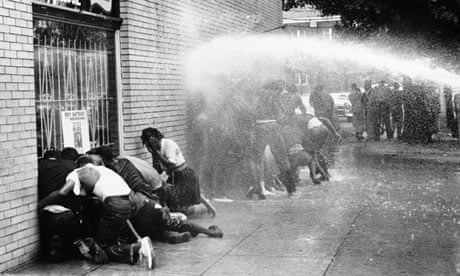
These images aren't new to me but for some reason, with the release of Selma, these images have taken on a new life.  Maybe it's the juxtaposition of the release of Selma so close to the chaos of Ferguson.  Maybe it's just that for the first time these images are really personal because I've had to do some real thinking about how the movie previews for Selma are going to impact someone close to me since my kids are old enough to see the images and have some heavy questions about that period of American history.

That's one of the parts of being brown that you cannot escape.  Your story, even though it may be many generations removed from today, is born out of a sad, unjust history.  With that in mind, my kids were pre taught the basics of slavery and the Civil War and the Civil Rights movement prior to kindergarten because I did not want them hearing even tidbits about that for the first time, while sitting in a room surrounded by their peers.  

I think these pictures also provide valuable context into some of what has happened regarding the justice system, the police, and the black community.  1963 seems like a long time ago.  But 1963 really isn't that long ago.   Especially when you or your parents or grandparents were personal witnesses to the events of the Jim Crow south.  I do not think for a minute that it justifies any of what has happened (especially violence and destruction) nor do I think it negates the dynamic progress that has occurred within the last 50 years.  But I do think it should give use pause as we think about why others may view situations differently than we do.

But back to these images and my own reaction.  It is one thing to know in your head that the words and actions of our past are intensely painful.  It's another to watch pieces of that play out on the faces of your own children.  Until you have had to sit and explain it to your own brown babies, it's just not quite the same.  

Because how do you explain that at some point in time people thought it was okay to use them as slaves without them hearing a message of "I am brown and someone says I am less than human." 

Because how do you explain, that at some point in time people thought they should be kept separate from white people without them hearing the message "I am brown and I am so different."  

Because how do explain that at some point in time people routinely used violence to perpetuate a system of inequality and hatred without them hearing the message "I am brown and people resisted change so they could keep being mean to me."  

It's about eyes that darken a bit in shame and eyes that flash over the injustice.  It's about our shame as a nation becoming their own personal shame.  Perhaps that's the biggest thing I want my kids to know.  This is not their shame.  This-this complicated, ugly history-it's our history not just theirs.  We may not have lived it and while we certainly can't live in the past, it is a jagged, broken part of who we are and were as a nation.  It is not theirs alone to bear.

It's also about hope.  Go back and look at that first image I linked.  It's taken in Little Rock, when the Little Rock Seven integrated the public high school.  Look at the row of angry white women just behind the black teen.  See the one in the middle?  She actually wasn't a woman at the time.  She was a classmate of the black teen.   At the time, she taunted and yelled and fought hard to avoid integration.  Years later, Oprah reunited the Little Rock Seven on one of her shows.  Oprah also found three of their white classmates and brought them to her show as well.  All were adults in their 40's.  The show featured both the white girl and the black girl from the original image.  I can only imagine the words used on that day on the Little Rock Street.  I don't have to image the words said on the Oprah stage because I heard them for myself.  On Oprah's stage, these all grown up women met yet again, and the white woman offered an tear filled apology.  She was clear that she was raised by parents who supported racism but that the cycle of overt, in your face racism ended with her and her children.  

So maybe that's the other lesson of all of this:  that there is always room for reconciliation and hope.    Our nation is certainly not perfect.  I dread the day when my son has to deal with the n word as used by so many high school boys who think they are too cool and he feels like perhaps he has to go along to get along.  I already know the pain of my kids being told they can't play because they are brown.  Even if not said out of outright racism, even if just said by kids as a way to be mean with no real understanding of the racial aspect of it, it has left its mark on my child's brain.  But even knowing that, there's hope and forgiveness and that is the legacy of Selma.

Friday, July 18, 2014

"Those Mexicans"

A gate got left open last week and Bo, the Basset Hound, escaped.  A knock on the door alerted us to the issue as a woman who lives a few streets over had an inkling he belonged to us.  We visited for a bit in the street as I got Bo out of her van.  She was simply trying to be neighborly, to help us.  Because "those Mexicans drive so fast down that street and I was afraid they would hit him."

Ugh! Even though she didn't say "those Mexicans" with a disparaging tone, that phrase is heavy, one that reminds me of an old tire that has filled with water and sunk to the bottom of a farm pond.  The thoughtless discarding has created a bogged down, muddy, stinky mess that over time gets mired into the muck, slowly sinking into the silt of the pond bottom.  Do I think that this woman is racist?  While I admit I don't know her all that well, I would say it is highly unlikely she is a dyed in the wool racist.  It is much more likely that she has never had to consider her words or how they sound.     She has never thought about how annoyed she would be if a group of Hispanics described her peer group in similar terms, as "those white ladies who are always yelling at their kids" or "those white ladies who park funny in the Walmart parking lot."  (Or whatever irritating or irresponsible thing it is that we white ladies do.)  She has never thought about how hearing the phrase "those white ladies" once or twice might not be such a big deal but that by time number four or five or thirty three, you're kind of over it as the phrase starts to weigh on you.    (And that doesn't even cover the fact that there is a good chance "those Mexicans" are not even Mexican at all.  There's a good chance they are Guatemalan, Honduran, El Salvadorian, or horror of all horrors, simply plain old American.)

At the time, I didn't reply but repeated my thanks and took the dog inside.  Of course, I was thankful she brought him home.  But the whole conversation regarding "those Mexicans" left me with a sour taste in my mouth.  My three brown kids all heard her say those words.  My three brown babies all heard me ignore the comment, perhaps assuming that I didn't think it was that big of a deal or that I, as a white woman, was ignorant of the implications of the words.  Would I have ignored those comments if the woman had told me how she was concerned because "those black kids just drive too fast?"  

Her words left me in a quandary that I mulled over for the afternoon.  Does my silence equate agreement?  Does my silence allude to a color blind mom who is unaware of the complexities of race in our country?  In a perfect world, I perhaps would have pointed out the words the woman said, asked my kids how they felt about it, and then rectified all problems related to race in a neat three step plan that my children eagerly agreed to follow and then teach to others.  But I didn't.  While my kids do recognize race and while my two older kids have been pre taught a bit about slavery in anticipation of Lincoln's birthday and Martin Luther King Junior Day, I am not quite ready to have to point out the words of others.  I don't want to have to point out those words and have that conversation.  I just don't.  They're 7 and I'm just not ready.   


Thursday, January 2, 2014

Deuling Pianos

Ever been to a piano bar with dueling pianos?  Can't say that I have but I love the idea.  Especially the idea if it's based in the roots of dueling pianos, which is old fashioned rag where two pianists try to play faster and better, each trying to outdo or one up the other.

Dueling pianos is a musical marvel, a chance for an audience to hear fingers dance and create a frenzy of jazz.  Not so with race relations.  In our modern world, with a 24 hour news cycle, what should be a stage for meaningful conversations on race instead turns into a malay of trying to prove who is right and who is wrong much like a set of dueling pianos set on proving their "rightness."

Aisha Harris sparked off a crazy firestorm in the media by writing "Santa Should Not Be a White Man Anymore."  Fox's Meghan Kelly quickly replied that he was indeed white, just like Jesus.  Paula Deen lost her cooking empire based on her comments on race.  And Phil Robertson, while originally criticized for his stance and crass criticism of homesexuality, also made the headlines for his comments on being black in Louisiana in the 50's and 60's.

It seems as if there are two issues preventing American from having the kind of dialogue that would actually be beneficial and both are about the inability or unwillingness to consider the perspective of someone else.  For many caucasians, the term "racist" carries heavy connotations.   In a lot of ways, being called a racist means being lumped into a category with other vile offenders.  Child molesters.  Wife beaters.  Racist.  So when a person of color asserts that the reason Santa is traditionally white is because of racism, most white people recoil and bristle because they feel like they have just been called a racist.  For most white people, racism is about calling names, physically harming someone, or discriminating against someone by refusing to hire them, rent to them, etc..   That is not who most white people are or who they want to be associated with.  Harris renames white privelege as "white by default" and for many white people, the idea that the world is set up in a way that encourages life to be "white by default" is a bit foreign and certainly not teh racism they understand.

While overt racism is always wrong, white people often find themselves stuck in a murky no man's land, where they are darned if they do and darned if they don't.  Step up the plate and say that you love all kids regardless of color by daring to adopt transracially and face the fire of the critics who say you can't possible raise a black child.  Recently an MSNBC host used Mitt Romney's black grandson as political fodder on her show.  I personally thought her comments were in poor taste, not because the baby was black, but because he is a baby being drawn into political grudgematch.  That said, many felt that her comments were an affront to transracial adoption.  Others saw her comments as an opportunity to talk about transracial adoption.  In Kieran Romney and the Paradox of Transracial Adoption, white parents are urged to consider how their whiteness might get in the way of their black child's identity and their child's ability to understand what it means to be black in America.  While the author is not against transracial adoption, can you imagine the outrage if a white person dared to ask if white parents really are capable of raising a black child?  That person must surely be maintaining the old tradition of keeping whites with whites and blacks with blacks.   Slap-there goes the racist label being applied yet again.  

In the same vein, whites find themselves unsure of where they should stand on controversial issues like immigration reform, stop and frisk, or the causes of poverty in inner city America.  If one asserts that these issues are about something other than racism or skin color, then you are simply out to oppress a minority group.  Even identifying someone by race, becomes a big question mark for whites.  Is it racist to describe someone by their skin color when, dependent upon the situation, that might actually be the most discernable feature of that person?  And let's not even get into the conversation of what you should call someone who has brown skin.  Calling all Hispanics "Mexican" is wrong.  Using the n words is wrong.  (Even though plenty of black people seem to use it when with their peers or in music.)  But should you call a black person "black", "a person of color", or "African American?" 

I am not saying this in a "pity the white man" voice; what I am saying is that the current racial climate leaves peach skinned people longing for some solid footing.  What would be helpful is for black people to understand that there are a lot of white people who are trying but who fear the backlash of doing or saying something wrong.  What would be helpful is for white people to be given grace rather than instantly accused.  What would be helpful is for there to be real, grown up conversations where we all don't have to agree and where labeling (and name calling) is discouraged.  What would be helpful is for black people to not expect all whites to have a uniform and clear view of what constitutes racism when black culture struggles to define the very same thing.

Likewise, most white people have had the privelege of being white.  They can go into a big name box store and find shampoo and conditioner for their hair type.  (Just an FYI, when I first adopted our kids, there was a section of about 5 products available at the big stores in Lincoln.  No wait.  Actually, the products were only available at one big box store, Walmart.  And this was in Lincoln.  A town of 200, 000 people with a decent black population.  This has now improved and Target and Walgreens carry a pretty decent selection.)  White people have band aids that match their skin type.   White people can easily find dolls that represent their children.  (Try finding a black baby doll that is a boy at a Target, Walmart, or Toys R Us.  You might find a black baby girl.  You will for sure find a variety of caucasian dolls, primarily girls but certainly a few boys too.  But a black baby boy?  Good luck.)  As Harris points out, the Macy's Day Parade features a white Santa.   (Perhaps because Santa has historically been white because of his origins as St. Nicolas?  But that's another discussion.)  

On television and in books, the last 30 years has seen a huge shift in what is available featuring black characters.  But even 20 years ago, Little Black Sambo was still a Little Golden book and the majority of television shows and books featured white families sans the Cosby's.  In fact, the majority of roles for blacks on television were stereotypes.  I just saw an interview with Malcolm Jamal Warner who played Theo Huxtable on The Cosby Show where he described his audition for the part. Essentially, he went in as a 13 year old who tried to act "black."  As in the "black" that was being portrayed on tv.  Bill Cosby pulled him aside and asked him if he would talk to his own father like that to which Warner replied, "No."  Warner re read the part then, not as a black teen trying to be "black" but as a black teen trying to be a teen and got the part perhaps because he was able to take Cosby's redirection.

Most white people will never question if the reason they were not hired was because of their skin color.  (Or question if it was the reason they were hired because of affirmative action.)  Most white people have never walked into a room where they were the only person of their skin color.  Most white people have been stared out but wondered if they had toilet paper on their shoe rather than wondered if it was because they were the wrong color in the wrong place.  Most white people have not moved and worried that their new neighbors may snub them because of their race.  But most whites can appreciate how those things feel because even if they haven't experienced them in connection with their skin tone, they have been passed over, felt socially awkward, or had neighbors who were hard to get along with it.  

And that is the rub:  white people have to start accepting that the black experience is not the same as the white experience. (And that there is not a singular black experience.)   A black person's perception of an experience belongs to them, and in their mind is reality.  (Just like anyone's experiences of rejection, hurt feelings, or mean people are his own and what forms his reality.)  You don't have to agree with their perception.  It is not about agreeing.  It is about sympathizing with someone, about recognizing that they were hurt or disappointed or angry and responding with a nurturing loving heart rather than a dismissive one.

So let's step away from the piano and quit banging on the keyboard.  All we seem to be creating is noise.  Could we instead focus on loving and understanding, on being the change we want to see and avoiding the clanging and dischord?  No matter how wise we might be or how right, "If I speak in the tongues[a] of men or of angels, but do not have love, I am only a resounding gong or a clanging cymbal."  (1 Corinthians 13:1)

Sunday, December 15, 2013

Is "The Talk" Really Necessary?

One wouldn't think that old school Marvin Gaye and a few framed photos of our president and his wife would make a person feel like she's been deposited into new, unfamiliar territory.  But when you are the white Mama of a black boy, the trappings of the local black barbershop have that effect.  Perhaps that first visit was the "you're not in Kansas feeling" that showed me how different my black children's lives will be than those of other black kids.  

Or maybe it was the recent kerfuffle that existed because Fox News' Meghan Kelly said that Santa and Jesus were white.  As I watched several black panelists remark on how their homes all contained black Santas and Black Jesuses, I was again reminded of how our family is a white family raising black children.

I am aware that being a transracial family has its unique dynamics.  I've read lots of memoirs of those who were adopted into white families and tried to hear their words on how to honor the skin color of your children.  I've been in several online forums where other moms are parenting across race.  But still, there are these moments that sting and shock and remind.

I guess I was blessed to be born into a time and place where I learned to treat others with kindness no matter how different they were from me.  I had experiences that taught me people are more alike than they are different.  And perhaps I had the privilege of being white.

I'm a face value person, someone who believes it's important to not create drama or read too much into the actions of others.  So the idea of "white privilege" (the concept that there are certain unsaid perks that come about by being white) doesn't necessarily sit well with me.  I think my own experiences and my own attitudes regarding others makes it hard for me to believe that minorities are treated differently.  For many white people, I think the following is probably true.  "Many people in the United States hailed the election and re-election of Barack Obama as the first black President as proof that the United States had become a post-racial society. But race does matter. And the fact that most white parents had never heard of "The Talk" before Trayvon Martin's death, New York's "stop and frisk" policy or Barney's and Macy's controversies are a few examples of how it matters."  Is the fact that our white culture is often unaware or quickly dismissive of these events the best illustrator of what white privilege looks like?"  (From The Huffington Post article, "When White Parents Have 'The Talk' With Black Sons.)

That said, I'm also a big believer in using common sense.  Like when you are a teenage boy who wears his pants around his ankles, his hat on sideways, and an oversized hoodie, that others are going to make assumptions about you regardless of if you are black, white or purple.  Add in a few more similarly dressed teens who might behave loudly or boisterously, the current teenage vocabulary which often involves crude language and swearing, and I think you would be hard pressed to not see why others might think the worst.  (In others words, I believe that we tell people how to treat us and when we dress or act or talk in a certain way, it is telling people what to believe about us.  There is simply an element of human nature that I don't think can be erased; we make judgments all the time based on how things appear on the surface.) 

But I am also the wife of a man who coaches a group of very diverse teenage boys.  I have unfortunately been a spectator to the words of others regarding these boys and their backgrounds, their abilities to speak English, and general temperaments.  I am also the mom of kids of color and while we have never been treated poorly because of our family make up, I'm sure there will be a day when that is not true.  More than anything, I am sure there will be a day when my kids are smacked into reality by overt racism.  

But what about the not so in your face?  What about the idea that white privilege exists because Santa and Jesus are almost always portrayed as white?  What about the idea that if you are white you will probably not be followed by store security?  What about going to the store for band aids and realizing flesh colored really means peach flesh and being annoyed?  Will my kids experience those things?  And what's my role as parent in  preparing them for that?  

Do you do as one parent suggests and make sure you have "The Talk" with your young black son because you are guessing he will be pulled over by police and not given the benefit of the doubt? Or is that based in the faulty assumption that all black parents have such discussion with their kids, when the reality is they don't?  (Or could it be that all kids should know what do when pulled over by the police, that it is simply common sense to be calm and respectful.  That perhaps teaching your children the following skills, as suggested by the authors of "The Talk" post, really is kind of a no brainer.  "Show your hands, smile, do not appear threatening and never talk back.") 

I don't have any easy answers for that.  I don't want to created jaded kids who perceive the world as racist or even just stacked against them.  Yet, I do need my kids to have a realistic perception of life and most importantly, wise and measured actions to how to respond to any situation where they are being treated unfairly or where they are feeling a bit slighted.  Sigh.  May I have wisdom for the moments and steady hope for our world, that all people will learn to treat others with respect and kindness, even in the ugly moments.